Why an NJ Family Court Hearing Is Never “Informal”
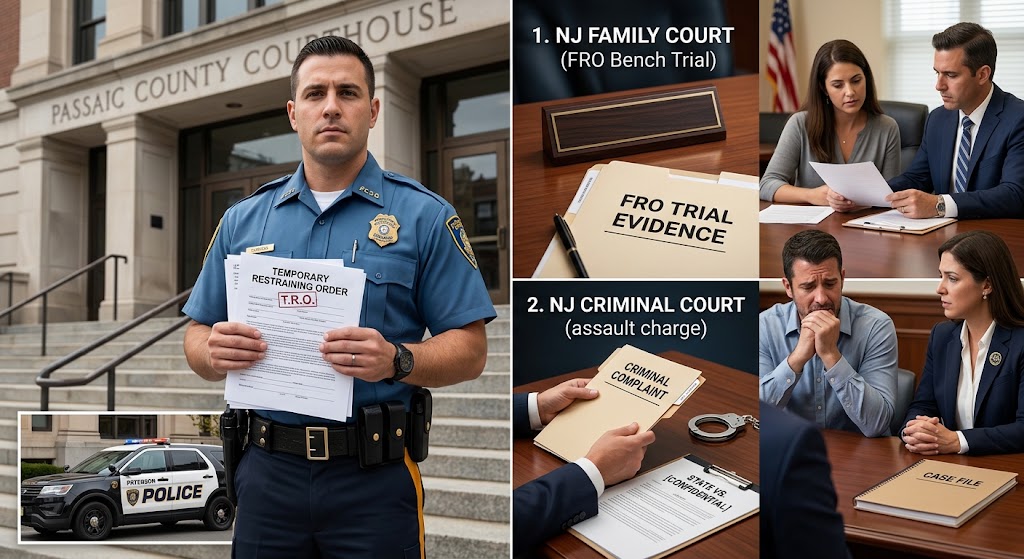
A single domestic dispute in New Jersey can trigger an immediate legal avalanche across two distinct court systems. Within forty-eight hours, you can find yourself served with a civil Temporary Restraining Order (TRO) through the Family Part while simultaneously facing complaint-warrants for criminal offenses such as simple assault, harassment, or terroristic threats.
Many defendants assume that these two actions are handled together by the same judge. In reality, they run on completely separate tracks, carry vastly different legal standards, and demand an aggressive, synchronized defense.
What happens inside a family courtroom does not stay in Family Court. A misstep in your civil restraining order hearing can permanently cripple your pending criminal defense, your career, and your freedom.
Two Courts, One Incident: Understanding the Dual-Track System
Under New Jersey’s Prevention of Domestic Violence Act ($N.J.S.A.\ 2C:25-17$), a restraining order begins as an emergency civil matter heard in the Family Part of the Superior Court, Chancery Division. At the same time, any criminal complaint arising from the same incident is filed through the local municipal court or the county prosecutor’s office in the Law Division, Criminal Part.
While both matters originate from the same domestic disagreement, the rules of engagement are starkly different:
- The Burden of Proof: In your criminal case, the State must prove guilt beyond a reasonable doubt. In a Final Restraining Order (FRO) trial, the plaintiff only needs to prove the allegation by a mere preponderance of the evidence—meaning “more likely than not” (just over 50%).
- The Fifth Amendment Dilemma: You have an absolute constitutional right to remain silent in your criminal case. However, if you choose to testify in your Family Court FRO trial, every word you utter under oath can be subpoenaed, transcribed, and weaponized against you by the prosecutor in your criminal case.
- Independent Outcomes: Winning a dismissal of your municipal criminal charges does not automatically dismiss your civil restraining order. The Family Court judge can still enter a permanent FRO against you on the exact same underlying facts.
If you are navigating simultaneous civil and criminal allegations, review our dedicated guides to New Jersey Family Law and aggressive New Jersey Criminal Defense.
The Illusion of the “Informal” Family Courtroom
Walk into a Law Division criminal courtroom, and the gravity is undeniable: armed sheriff’s officers, formal jury boxes, and prosecutors in robes or dark suits. Step into an initial Family Part hearing, and the environment may appear deceptively conversational, intimate, and administrative.
This relaxed aesthetic is dangerous. Many defendants mistakenly believe they can simply sit before the judge, share their side of the story in their own words, and assume the court will understand that the dispute was mutual.
Make no mistake: an FRO hearing is a full-blown bench trial.
Judges do not make decisions based on casual conversations. They rule strictly on competent, admissible evidence, legal credibility, and statutory predicates.
If you show up to an FRO trial without formal evidence, without properly authenticated exhibits (such as certified text records, metadata-verified voicemails, or date-stamped surveillance), and without knowing the New Jersey Rules of Evidence, the court will bar your proof. While you attempt to explain your story, an experienced opposing attorney will dismantle your credibility through cross-examination.
An FRO Follows You Forever: The Lifelong Repercussions
Unlike in many other states, a Final Restraining Order in New Jersey never expires. There is no sunset clause. Unless an appellate court overturns it or the court formally dissolves it under the strict Carfagno factors, an FRO remains active for the rest of your natural life.
An FRO is not merely a directive to stay away from an ex-partner. It carries profound institutional consequences that alter how the justice system treats you forever:
- Universal Law Enforcement Visibility: Once an FRO is entered, your name, fingerprints, and photograph are logged into the New Jersey Domestic Violence Central Registry and the FBI’s National Crime Information Center (NCIC). Whenever a police officer runs your license plate or checks your identification during a routine traffic stop, an immediate alert flashes on their mobile terminal.
- Prosecutorial Bias in Future Inquiries: If you are ever investigated or questioned in connection with a future dispute, detectives and assistant prosecutors immediately pull your central registry history. The presence of an active FRO directly influences whether prosecutors approve elevated indictable charges, oppose your pretrial release, or refuse to offer diversionary programs like Pre-Trial Intervention (PTI).
- Employment and Security Clearances: An FRO is an official civil court judgment. It consistently surfaces during pre-employment background checks, professional licensing applications (including healthcare, teaching, and commercial driving), FINRA registrations, and security clearance renewals.
- Total Loss of Gun Rights: Under New Jersey law and federal statute ($18\ U.S.C.\ \S\ 922(g)(8)$), an active FRO permanently bars you from purchasing, possessing, or owning firearms or ammunition. Any existing firearms must be surrendered immediately.
- The Threat of Criminal Contempt: After an FRO is entered, even an unintentional interaction—such as sending a congratulatory text, accidentally walking into the same grocery aisle, or having a third party pass along a message—is treated as a criminal contempt charge ($N.J.S.A.\ 2C:29-9$), carrying mandatory jail time for repeat violations.
Case Study: Synchronizing the Civil and Criminal Defense
To illustrate how these proceedings intersect, consider an educational scenario representing a common crisis our trial attorneys handle in Northern New Jersey:
1. The Situation
A client in Passaic County had a dispute with an estranged spouse during an exchange of parenting time. Days later, the spouse filed for an emergent Temporary Restraining Order, alleging harassment and terroristic threats. Concurrently, the local police department served the client with a municipal court criminal summons for simple assault and harassment, accompanied by an order to surrender his hunting firearms.
2. The Legal Conflict
The FRO trial was scheduled in the Passaic County Family Part within ten days, while the criminal charges were still pending initial disposition. The client initially intended to represent himself at the FRO hearing, believing text messages showing mutual arguments would clear his name. However, testifying openly in Family Court would have provided the municipal prosecutor with sworn testimony that could have locked in a conviction in the criminal case.
3. The Resolution
Our attorneys entered appearances in both courts. We secured a strategic adjournment of the Family Court trial to complete targeted discovery, subpoenaing full cellular metadata and nearby commercial surveillance footage. At the FRO trial, we demonstrated through cross-examination and strict evidentiary objections that the plaintiff’s claims failed the two-prong Silver v. Silver test: no predicate act of violence had occurred, and no ongoing order of protection was necessary. The judge dismissed the TRO in its entirety. Leveraging the Family Court dismissal and sworn transcripts, we subsequently obtained a complete dismissal of the parallel criminal complaint in municipal court and successfully petitioned for the return of our client’s seized property.
4. The Takeaway
Never treat a domestic violence allegation as a routine family argument. The Family Court trial must be prepared with the rigor of an indictable criminal trial, balancing evidence, witness preparation, and constitutional protections against self-incrimination.
Where Your Case Will Be Litigated in Northern New Jersey
Because domestic violence matters cross jurisdictional boundaries, where you live and where the incident allegedly took place determine your courtroom venue:
- For Passaic County Matters (Paterson, Clifton, Wayne, Totowa, Little Falls): Your domestic violence restraining order hearings are litigated at the Passaic County Courthouse located at 77 Hamilton Street in Paterson, just blocks away from our historic Church Street headquarters. Any indictable domestic violence crimes are managed by the Passaic County Prosecutor’s Office in the same complex, while disorderly persons offenses remain before the local Municipal Court in Paterson, Clifton, or Wayne.
- For Bergen County Matters (Hackensack, Paramus, Ridgewood): Restraining order hearings and related criminal offenses originating in Bergen County are heard at the Bergen County Justice Center in Hackensack. Our satellite office in Ridgewood provides a convenient, confidential location for clients in Paramus, Hackensack, and surrounding communities to meet with our trial team and construct their defense.
Facing an FRO Hearing or Domestic Charges? Protect Your Record Today
A Final Restraining Order creates a permanent public mark that alters your career, your family rights, and your standing before law enforcement forever. You cannot afford to walk into an NJ Family Court hoping the judge simply takes your side without rigorous legal proof.
Put over a century of Northern New Jersey courtroom experience on your side. Call Raff & Raff today at 973-742-1917 or schedule a confidential consultation with our trial team on our Criminal Defense or Family Law pages.
Raff & Raff, LLP has defended the rights of Northern New Jersey families and individuals since 1922. We provide seamless civil, family, education, immigration, and criminal representation across Passaic and Bergen counties, including the local communities of Clifton, Wayne, Hackensack, Paramus, and Totowa & Little Falls. Contact us today to schedule a free in-office or face-to-face Zoom consultation